

Search engines have become far more intelligent in recent years. In 2026, Google and other platforms rely heavily on AI systems, user behaviour signals, and quality guidelines such as E-E-A-T (Experience, Expertise, Authoritativeness, Trustworthiness) and Helpful Content to decide which pages deserve to rank.
Yet, one controversial technique still appears in discussions: cloaking in SEO.
If you’ve ever searched for what is cloaking, or heard terms like SEO cloaking or cloaking SEO, this guide will explain everything clearly—what cloaking is, how it works, why some websites still try it, and why it is considered a high-risk, penalty-prone practice in modern search engines.
More importantly, we’ll also show you safe, future-proof alternatives that actually build long-term rankings.
What Is Cloaking in SEO? (Clear Definition)
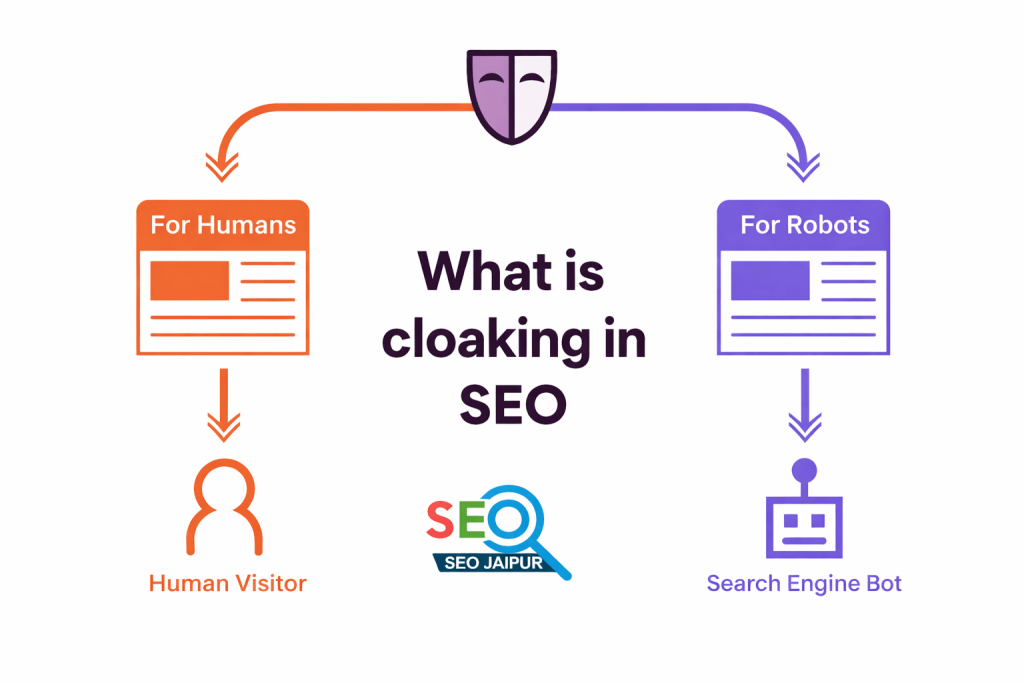
Cloaking in SEO is a technique where a website shows one version of content to search engines and a different version to human users.
In simple terms:
Search engine bots see one page
Real visitors see another page
The main goal of SEO cloaking is usually to manipulate search rankings by showing keyword-rich or optimised content to search engines while showing different (often sales-focused or unrelated) content to users.
Because this practice intentionally misleads search engines, it violates Google’s Webmaster Guidelines and is considered a black-hat SEO technique.
How Cloaking SEO Works (At a Technical Level)
Cloaking typically works by detecting who is visiting the page and serving different content based on that identity. This can be done using:
IP address detection (bots vs real users)
User-agent detection (Googlebot vs browser)
JavaScript-based methods
Server-side scripts that switch content dynamically
For example:
Googlebot sees a page full of keyword-rich text about “cheap flights”
A real user sees a page selling unrelated products or displaying ads
This mismatch between bot content and user content is exactly what makes cloaking SEO deceptive.
Why Websites Used Cloaking in the Past
In the early days of search engines, algorithms were much easier to manipulate. Some site owners used cloaking to:
Rank for highly competitive keywords
Show cleaner, more optimised pages to bots
Redirect users to sales pages or affiliate offers
Hide low-quality or spam content from search engines
Push aggressive ads while keeping bots “happy”
For a short time, these tactics sometimes worked. But search engines have evolved—and today, the risks far outweigh any short-term gains.
Is Cloaking in SEO Allowed?
No. Cloaking is explicitly listed by Google as a violation of its spam policies.
If a search engine detects that your site is showing different content to users and crawlers with the intent to manipulate rankings, your website can face:
Partial ranking drops
Removal of specific pages from the index
Manual actions (penalties)
Complete deindexing of the website
Long-term trust loss, even after cleanup
In 2026, with AI-based detection systems and improved crawling, cloaking is easier than ever for search engines to spot.
Cloaking vs Legitimate Content Personalisation (Important Difference)
Not all content variation is bad. There is a big difference between deceptive cloaking and legitimate personalisation.
Legitimate Examples (Usually Safe)
Showing different languages based on user location
Adapting layout for mobile vs desktop
Personalising content for logged-in users
A/B testing page designs
Cookie-based content preferences
Risky or Prohibited Examples
Showing keyword-stuffed pages to bots and sales pages to users
Hiding affiliate links or spam from crawlers
Serving completely different topics to search engines and visitors
Using scripts to mask real content from bots
The key rule is simple:
What search engines see should represent what users actually get.
How Google Detects SEO Cloaking in 2026
Modern search engines use multiple systems to identify cloaking, including:
AI-based content comparison (bot vs user views)
Chrome and user data signals
Multiple crawler types and locations
Manual quality reviewer checks
Behavioural signals (bounce rate, engagement mismatches)
Pattern analysis across websites and networks
Because of this, cloaking SEO is no longer a “clever trick”—it’s a fast way to damage your site’s long-term visibility.
Real-World Risk: Why Cloaking Is a Bad Business Decision
From a business perspective, cloaking is risky because:
You are building traffic on unstable foundations
One update or manual review can wipe out your rankings
Recovering from penalties can take months (or longer)
Your brand’s trust and credibility can be permanently harmed
You waste money on short-term tactics instead of real growth
In contrast, modern SEO focuses on trust, authority, and user satisfaction—not tricks.
Safe, Future-Proof Alternatives to Cloaking
If your goal is to rank better and convert more users, here are ethical, effective alternatives:
Create genuinely helpful, in-depth content
Use proper on-page SEO and clear site structure
Improve page speed and user experience
Build authority with editorial backlinks and mentions
Use structured data for better search understanding
Optimise for search intent, not just keywords
Localise or personalise content without deception
These methods align with E-E-A-T and Helpful Content principles and actually work in 2026.
Cloaking in SEO vs White-Hat SEO (Quick Comparison)
| Aspect | Cloaking SEO | White-Hat SEO |
|---|---|---|
| Compliance | Violates guidelines | Follows search engine rules |
| Risk Level | Very high | Low and stable |
| Results | Short-term, unstable | Long-term, sustainable |
| Trust | Damages brand trust | Builds credibility |
| Detection | Increasingly easy for Google | No penalty risk |
| Business Impact | Unpredictable, risky | Reliable growth |
Key takeaway: If you are building a real brand or business, white-hat SEO is the only sensible choice.
Frequently Asked Questions (FAQs)
What is cloaking in SEO in simple terms?
Cloaking in SEO means showing different content to search engines and to real users in order to manipulate rankings. It is considered a deceptive and prohibited practice by Google.
Is cloaking SEO ever safe to use?
No. If the intention is to mislead search engines, it is against guidelines and can result in penalties or deindexing.
Can personalisation or geo-targeting be considered cloaking?
Not necessarily. If both users and search engines can access equivalent content and the changes are for usability (language, device, location), it is usually fine. The problem starts when content is hidden or misrepresented.
What happens if Google catches a site using SEO cloaking?
The site may receive ranking drops, manual penalties, or even be removed from Google’s index entirely.
Why do some websites still use cloaking?
Usually for short-term gains, aggressive affiliate marketing, or spam tactics. However, these sites often disappear from search results sooner or later.
What should I do instead of using cloaking?
Focus on quality content, user experience, technical SEO, and building authority through ethical, long-term strategies.
Final Thoughts: Cloaking Is Not Worth the Risk in 2026
If you are serious about building a stable, trustworthy, and visible online presence, cloaking in SEO is not the path forward. Search engines are smarter, users are more demanding, and brand trust matters more than ever.
Modern SEO is about:
Helping users
Demonstrating real expertise
Building authority over time
And earning visibility, not tricking algorithms
If you want sustainable growth, choose transparent, white-hat SEO strategies that will still work years from now.